
If you want to know how to improve self-awareness, start with a simple question: How do other people experience me? Self-awareness means seeing your feelings, habits, strengths, blind spots, and actions clearly, along with the effect they have on others. It is a key part of emotional intelligence, stronger relationships, and better decisions at work.
Most of us assume we already have it. One widely cited finding says about 95 percent of people consider themselves self-aware, while only 10 to 15 percent meet a stronger standard for it. The gap exists because we can know our intentions without seeing our impact. You may think you are being direct while a coworker experiences you as dismissive.
Self-awareness grows through practice. Small habits help you compare your self-assessment with what is happening around you.
What is self-awareness in the workplace?
Self-awareness at work is the ability to notice what you feel, think, and do, then connect those inner experiences to your behavior and results. It includes recognizing your emotional triggers, understanding your strengths and weaknesses, and noticing how others perceive you.
That last part matters in ordinary moments. A customer may hear the rush in your tone, while a teammate stops sharing ideas after you reject them before exploring them. A direct report may bring you only good news because your reaction to problems feels unsafe. Self-awareness helps you catch the pattern before you explain it away.
It also gives you a pause between a feeling and a response. You can be annoyed without sending the angry email, nervous without avoiding the conversation, or tired without treating a routine question as an interruption. Instead, notice what you are bringing into the interaction and choose what happens next.
How do you improve self-awareness at work?
1. Ask for feedback about your impact
You know your intentions better than anyone else, but coworkers often see the effect of your behavior more accurately than you do. Ask two or three trusted people, such as a peer, manager, mentor, or direct report, to help you see that effect.
Make the request specific. Instead of asking, “How am I doing?” describe the impact you want to have: “I want people to feel comfortable raising concerns with me. Will you tell me when I create that feeling and when I make it harder?” This gives the other person something observable to watch for rather than asking for a vague judgment about your character.
If the feedback is negative, ask for an example. “Can you tell me what I said or did, and what happened next?” A specific example turns “You are intimidating” into a behavior you can work on, such as interrupting, using a sharp tone, or ending a discussion too quickly. Thank the person for coaching you, even when the message is uncomfortable. They are helping you become the person you say you want to be.
A 360-degree review can reveal patterns across a larger group. Trust grows when you listen without arguing and follow up with a visible change.
2. Practice active listening and complete presence
Self-awareness and active listening strengthen each other. When you notice your eyes moving to another screen, your attention drifting, or your mind rehearsing a rebuttal, you have found a moment to return to the conversation.
Try giving the person your physical, mental, and emotional presence. Put away distractions, keep your attention on what they are saying, and notice your reaction when their view differs from yours. Do not bring an old argument into a new conversation or decide what the person means before they finish.
This is close to the FISH! Philosophy practice Be There. At work, it might mean telling a teammate, “I want to give this my full attention. I have five minutes now, or we can talk at two,” and then truly being present at two. Set a time when you can listen well, and honor it.
3. Step back from strong emotions
Stress can make a feeling seem like a fact. Before you reply to an angry message or speak sharply in a meeting, create physical distance from the reaction. Turn away from the screen, take a short walk, breathe slowly, or notice where you feel tension in your body.
Then name the emotion more precisely. Instead of saying, “I am frustrated,” try, “I am experiencing frustration.” That small change reminds you that the feeling is real, while also giving you enough distance to observe it rather than obey it.
Ask yourself three questions: How will my response improve the situation? How could it make things worse? Is it likely to produce the result I want? The point is to see the reaction clearly enough to make a useful choice, not to pretend everything is positive. In the language of FISH!, that pause creates room to Choose Your Attitude.
4. Notice patterns, triggers, and assumptions
Keep a journal for a few weeks. Write down moments when your reaction feels much bigger than the event, including what happened, what you assumed, what you felt in your body, and what you did next. You can also set a reminder once or twice a day to ask, “What mood and stress level am I carrying right now?”
Look for repeated triggers. Maybe you become defensive when someone asks for a status update, impatient when a coworker tells a long story, or discouraged when a customer questions your work. Your history may be shaping the present. If you had a difficult run-in with someone last month, your brain may read a neutral comment today as another slight.
Judgments create similar blind spots. You may have labeled one coworker “whiny,” so you stop listening when they need help. You may have decided that another person’s ideas are impractical, so you say no before understanding them. Awareness does not require you to agree with everyone. It asks you to notice the label and test whether it is controlling your behavior.
Before the next conversation, ask: What am I expecting? What might I be missing? How could this person’s experience lead them to see the issue differently? That preparation makes it easier to Be There instead of reacting to an old story.
5. Turn reflection into action
Self-reflection is useful only when it changes what you do. Asking “Why did I lose my temper?” can reveal a cause, but it may leave you circling the same explanation. Follow the why with what and how: What can I learn? What behavior will I try next time? How can I practice it today?
For example, if you missed a deadline because you kept accepting urgent requests, your next step might be to confirm priorities before saying yes. If people say you dominate meetings, you might write down your point, wait until two others have spoken, and invite someone who has not contributed to share a view.
This is also where leaders can help. Model self-assessment by asking, “What am I not seeing?” Invite your team to discuss how they want meetings, handoffs, and customer interactions to feel. Recognize specific behaviors and their effect, rather than giving vague praise. A leader who catches people doing things right makes it safer for everyone to talk honestly about what needs to improve.
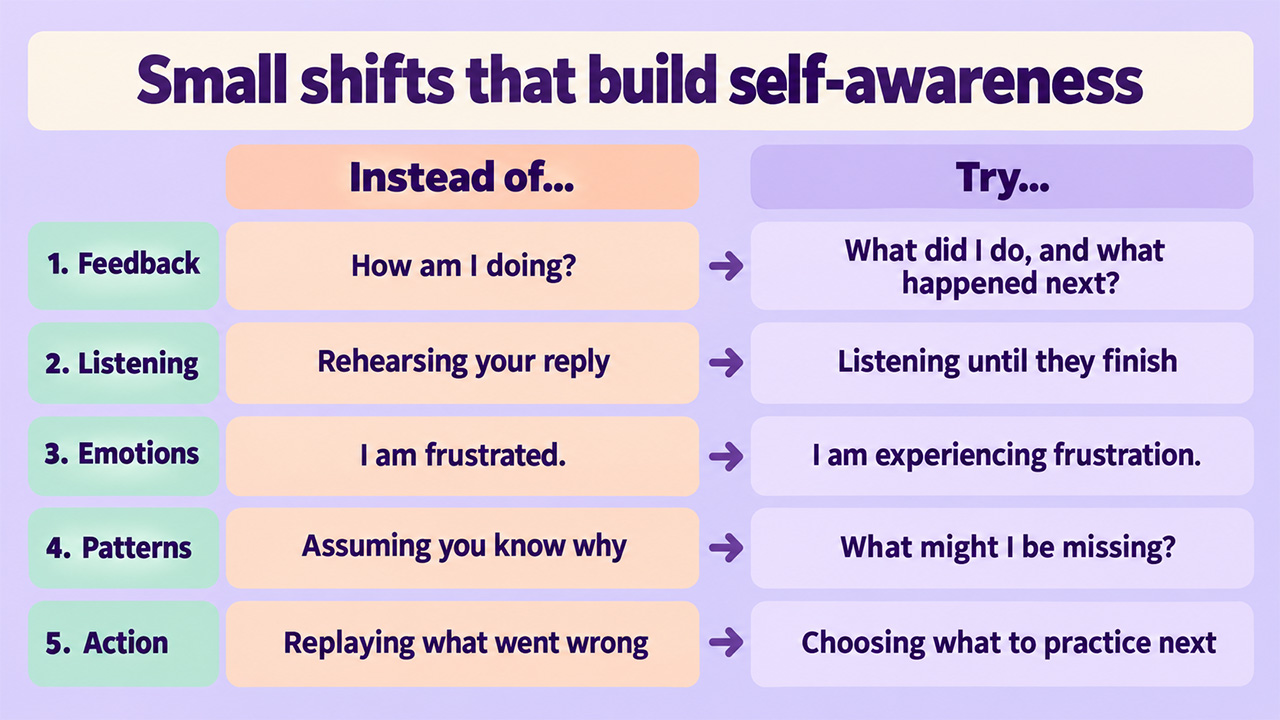
Five small changes in how you ask, listen, and reflect can make self-awareness part of your everyday work.
How do you predict your reactions before a difficult situation?
Self-awareness gets stronger when you practice before the hard moment arrives. Imagine the meeting with the long-winded coworker. You already know that your patience may disappear after ten minutes. Before the meeting, name the likely reaction and decide how you want to respond: “I may feel annoyed. I will listen for the main point, ask a clarifying question, and suggest a time limit if we need one.”
Use the same plan before a tense customer call or feedback that may sting. Identify the button, name the attitude you want, and rehearse one sentence that will keep you engaged.
How does self-awareness support the four FISH! practices?
The FISH! Philosophy is a way of being, built around four simple practices: Choose Your Attitude, Be There, Make Their Day, and Play. Self-awareness helps each practice become genuine rather than performative.
With Choose Your Attitude, you notice the mood you are bringing into the room and decide what will serve the situation. With Be There, you catch distraction, judgment, and defensiveness so you can offer complete presence. With Make Their Day, you notice what a customer or teammate needs and take a sincere action that shows their effort matters. Recognition might be a specific thank-you, a helpful handoff, or a moment of support when someone is having a hard day.
Self-awareness also makes Play more useful. Play means bringing curiosity, energy, and creativity to work; it does not mean acting silly or ignoring boundaries. If you know you shut down new ideas to protect yourself from risk, you can stay curious long enough to explore one. The other practices help keep that creativity respectful, safe, and helpful.
What does good self-awareness look like at work?
A self-aware person still gets tired, irritated, defensive, and wrong. The difference is that they notice sooner, accept useful feedback, and repair the impact. They can say, “I interrupted you, and I want to hear the rest,” or “My tone was sharper than I intended. Let me try that again.”
They understand that self-awareness keeps developing through conversation rather than becoming a score they earn once. Choose one ordinary team moment this week, such as a handoff, meeting, or customer interaction, and ask what people intended, how it landed, and what small change would help next time.
Seeing yourself clearly gives you more freedom: notice emotion without becoming it, hear feedback without treating it as a personal attack, and help people experience the best of who you mean to be.
Before you move on, consider these questions:
- Do you see yourself as self-aware, and what makes you say that?
- Which people, events, or workplace situations make you less reflective than you want to be?
- Which FISH! practice could you strengthen this week through greater self-awareness, and what action would show it?
Try the FISH! Philosophy with your team
Invite your team to try the FISH! Philosophy upgraded trial, which gives you 30 days of access to the FISH! film and its digital guides. Use the shared language to talk about how you show up, how others experience you, and what you can practice together in everyday work.

Frequently Asked Questions
Can self-awareness improve leadership skills?
Yes. Leaders who understand their effect on others can communicate more clearly, receive hard news sooner, and create more psychological safety. The next step is learning how to turn that awareness into coaching, recognition, and consistent behavior.
What is the difference between self-awareness and self-consciousness?
Self-awareness helps you observe yourself with curiosity and make a useful choice. Self-consciousness usually keeps attention locked on how you might look, which can make you withdraw or overreact; learning mindfulness and self-compassion can help separate the two.
Should I use a personality assessment to build self-awareness?
An assessment can give you language for preferences and patterns, but it is a starting point rather than a final answer. Compare its themes with real feedback and workplace examples so you do not use a label to excuse behavior or limit your growth.
How can mindfulness support self-awareness at work?
Mindfulness helps you notice thoughts, emotions, and body signals before they turn into automatic behavior. A few focused breaths or a brief check-in during the workday can create the pause needed to listen, question an assumption, and choose a more useful response.
How long does it take to become more self-aware?
There is no finish line, but small changes can show up quickly when you focus on one behavior and ask others what they notice. Treat it as a daily practice of noticing, choosing, acting, and checking the result.